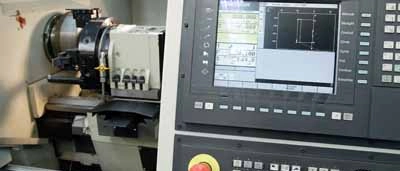
Dotmar’s CNC turning service delivers reliable, high-performance results for engineering plastics. We specialise in producing custom CNC turned parts designed to meet exact specifications across a wide range of industrial applications.
Using advanced CNC turning centres, our team machines plastic components with precision and repeatability, making it a practical solution for everything from prototyping through to low-volume production.
What is CNC Turning?
CNC turning is a machining process where material rotates while a cutting tool shapes it into the desired form. Controlled by computer programming, a CNC turning centre ensures each cut is accurate, consistent, and repeatable.
The process is ideal for producing round or tubular components with features such as threads, grooves, and internal bores. Because the process is automated, it reduces variability and allows complex geometries to be produced with tight tolerances and minimal error.
Advantages of CNC Turning for Engineering Plastics
CNC turning offers a range of benefits for plastic component manufacturing:
- High precision and dimensional accuracy
- Consistent, repeatable results across production runs
- Faster turnaround times
- Ability to produce complex shapes and detailed contours
- Smooth surface finishes with minimal post-processing
- Reduced material waste, improving cost efficiency
- Ideal for prototyping and low-volume production
These advantages make CNC turning a strong choice for applications where performance, reliability, and cost control all matter.
Materials and Industries Served
Dotmar works with a wide range of engineering plastics suited to CNC turning, including:
- PEEK for high-temperature and high-performance applications
- Nylon for strength and wear resistance
- Acetal for dimensional stability and low friction
- UHMWPE for impact resistance and durability
Each material is selected based on the specific demands of your application, whether that’s mechanical load, chemical exposure, or environmental conditions.
The versatility of CNC turning makes it an essential process for producing reliable, application-specific parts in a range of industries:
| Industry | Typical CNC Turned Parts / Applications |
|---|---|
| Automotive | Bushings, rollers, under-the-hood components |
| Aerospace | Lightweight, high-strength precision parts |
| Medical | Instrument components, specialised fittings |
| Electronics | Insulating components, housings |
| Industrial Machinery | Gears, bearings, valve components |
Dotmar's CNC Turning Capabilities
Dotmar invests in advanced CNC turning technology, including CNC swathes and programming software, to deliver precision and efficiency at every stage of production.
But our biggest investment is in our team. Our machinists bring extensive knowledge and experience working with engineering plastics. Their programming skills and attention to detail allow them to respond and adjust cutting strategies to optimise performance and finish.
Every job is carefully managed from initial setup through to final production to ensure accuracy, surface quality, and efficient lead times.
Quality Control and Assurance
Quality is built into every stage of our CNC turning process. Dotmar follows strict quality control procedures, including in-process inspections, final dimensional verification, and material checks.
Our systems are aligned with ISO 9001 standards, ensuring consistent outcomes across all projects. This structured approach allows us to deliver CNC turned parts that meet or exceed specifications, every time.
CNC Turning FAQs
1. What are the advantages of CNC turning compared to traditional turning methods?
CNC turning offers greater precision, repeatability, and efficiency. Automation reduces human error and allows consistent results across multiple parts.
2. Which engineering plastics are best suited for CNC turning?
Common materials include PEEK, Nylon, Acetal, and UHMWPE, each selected based on strength, wear resistance, and environmental performance.
3. How precise can CNC turning be for small features and tight tolerances?
CNC turning can achieve very tight tolerances, making it suitable for components requiring high accuracy and fine detail.
4. What industries commonly require CNC turning services for plastic components?
Automotive, aerospace, medical, electronics, and industrial manufacturing all rely on CNC-turned plastic parts.
5. How does Dotmar ensure the quality and accuracy of CNC turned parts?
Through in-process checks, final inspections, and strict adherence to ISO-certified quality systems.
6. What are the advantages and disadvantages of CNC turning?
CNC turning delivers precision, speed, and repeatability, though it may have higher setup costs compared to manual methods for very small runs.
Get Started with CNC Turning
If you need precise, reliable CNC turned parts, Dotmar is ready to support your project. Our team works with you to deliver tailored solutions that meet your exact requirements, from concept through to production.
Contact our team at Dotmar today to discuss your CNC turning needs and move your project forward with support from the experts in the industry.