Polycarbonate is tough, impact-resistant, and widely used across engineering, construction, and manufacturing. But when it comes to fabrication, one question comes up again and again: how do I cut polycarbonate sheets cleanly without cracking, chipping, or melting the edges?
The answer comes down to using the right method for the sheet thickness, controlling heat, and choosing the correct tooling. Done properly, polycarbonate sheet cuts cleanly and machines well. Done poorly, it can melt, grab, or leave rough edges that compromise both appearance and performance.
This guide breaks down how to cut a polycarbonate sheet step by step, with practical advice for engineers, fabricators, and workshop teams working with solid and multiwall sheets in real-world conditions.
Tools needed to cut polycarbonate sheets
The first step in getting a clean cut is choosing the right tool. Not all blades or machines perform the same, and using the wrong one is where most problems start. Coarse blades generate vibration and heat, leading to rough edges. Dull tools increase friction, which softens the material and causes melting.
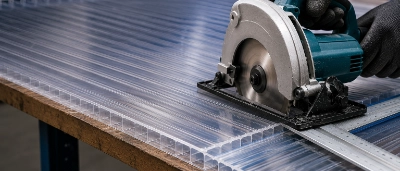
For straight cuts in thicker sheets (around 10 mm or more), a circular saw with a fine-tooth blade is the most reliable option. Use a blade designed for plastics or non-ferrous metals, with a high tooth count and a triple-chip grind (TCG) profile. More teeth deliver a cleaner finish, while the TCG geometry helps produce smooth edges without melting the material.
For curves or irregular shapes in sheets between 2 and 20 mm thick, a jigsaw or band saw with slow to medium speed gives better control. These tools reduce the heat and prevent the material from melting. For thin sheets (1.5-2.5mm) use a 1.5-2.0 teeth/mm (12-18 teeth per inch), and for thicker gauges (3.2-12mm) use 2.5-3.5 teeth/mm (7-10 teeth per inch).
For precision work and complex shapes and designs, CNC routing is the preferred method. It delivers consistent tolerances and repeatability, particularly for production runs or detailed components.
Step-by-Step: Cutting Polycarbonate with a Circular Saw
For most workshop applications with sheet thicknesses from 1mm to 12mm, a circular saw is the go-to method.
1. Start by securing the sheet on a stable surface. Support the sheet well to prevent vibration. Leave the protective film on the sheet during cutting; it helps reduce surface scratching.
2. Set the blade height just above the sheet thickness. This minimises unnecessary vibration and minimises the sheet climbing the blade or shattering. Use a moderate feed rate. Too slow and you generate heat, too fast and you risk chipping.
3. As you cut, focus on maintaining a consistent motion. Stopping mid-cut is one of the quickest ways to create melt marks or edge deformation.
4. Be mindful of the ambient temperature. On hot days, polycarbonate softens more easily. Adjust your feed rate slightly faster and avoid letting the blade dwell in one spot.
5.Once the cut is complete, inspect the edge. A clean cut should be smooth, with minimal burrs. If needed, light finishing with a deburring tool or fine sandpaper can improve the result.
NOTE: Although circular saw cutting is ideal for straight cuts and is fast and accurate, it's not suited for tight curves or complex shapes.
Cutting Curves and Complex Shapes: Jigsaw, Band Saw, and CNC Routing
When curves and shapes are needed, different tools come into play.
A jigsaw is useful for on-site fabrication and irregular shapes. Use a fine-tooth blade, run at a slower speed, and apply masking tape along the cut line to reduce surface chipping. Keep movement steady to avoid heat buildup.
A band saw offers better control for tighter curves and thicker sections. It produces smoother edges and reduces vibration compared to handheld tools.
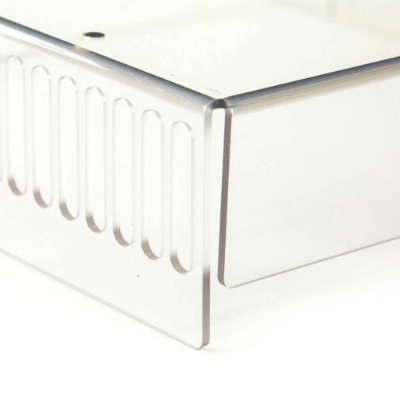
For high-precision work, CNC routing is the preferred option. It allows for repeatable cuts with finer tolerances, depending on setup. This is especially important for engineered parts like machine guards or enclosures.
In all cases, controlling heat is key. Polycarbonate sheet doesn’t crack easily, but it will soften if overheated, which affects edge quality.
Lasercutting polycarbonate: Advanced Techniques and Limitations
You’re probably now wondering: can polycarbonate be laser cut?
The answer is yes, but with limitations. CO₂ lasers can cut polycarbonate at thinner gauges, generally up to around 6 mm. Beyond this, the risk of melting, burning, or poor edge quality increases significantly.
Unlike acrylic, polycarbonate sheets don't vaporise cleanly under laser heat. Instead, it tends to melt, which can leave discoloured or uneven edges.
Fibre lasers are not recommended. They can create excessive heat and pose a fire risk.
Laser cutting is typically reserved for:
- Thin sheets
- Non-critical edge quality
- Specific prototyping applications
For most engineering uses, mechanical cutting methods remain the better choice.
Safety Protocols and Best Practices for Polycarbonate Cutting
Cutting polycarbonate is relatively safe, but it still requires proper precautions.
Always wear:
- Safety glasses to protect against chips
- Gloves for handling sharp edges
- A mask if fine dust is generated
Ensure adequate ventilation or dust extraction, particularly when machining larger volumes. Follow relevant Australian standards, including AS/NZS 1715/1716 guidance for respiratory protection.
Secure the material firmly. Movement during cutting leads to poor edge quality and increases the risk of tool kickback.
Watch for heat buildup during cutting. Polycarbonate isn’t highly flammable, but trapped swarf combined with rising temperatures can become a risk in enclosed spaces. Using a coolant or lubricant suited to polycarbonate helps control heat and clear chips more effectively. For smaller setups, air or light mist cooling can achieve similar results.
Frequently Asked Questions
| How to cut Lexan polycarbonate sheet? | Lexan is a brand of polycarbonate. It can be cut using the same methods—circular saws, jigsaws, or CNC routing—depending on thickness. |
|---|---|
| Can polycarbonate be laser cut? | Yes, but only at thinner thicknesses and with CO₂ lasers. Mechanical cutting is generally preferred for engineering applications. |
| Can you cut polycarbonate with a circular saw? | Yes. This is one of the most effective methods for straight cuts in thicker sheets. |
| Can polycarbonate be cut? | Yes. It machines well when the correct tools and techniques are used. |
| What’s the best thing to cut polycarbonate with? | It depends on the application. Circular saws for straight cuts, CNC routing for precision, and jigsaws for curves. |
| How do you cut polycarbonate without cracking it? | Use sharp tools, support the material, and control heat. Polycarbonate is impact-resistant, so cracking is rare if handled correctly. |
| Can you cut polycarbonate with an angle grinder? | Not recommended. It generates too much heat and leads to poor edge quality. |
| Can I use a jigsaw to cut polycarbonate? | Yes. Use a fine-tooth blade and run at a slower speed for best results. |