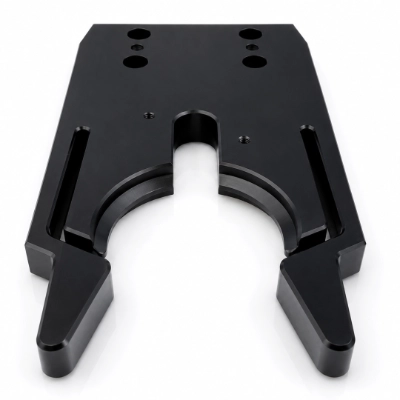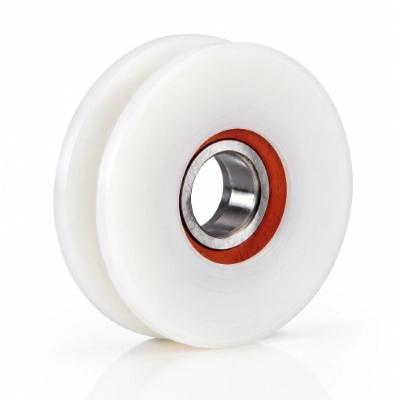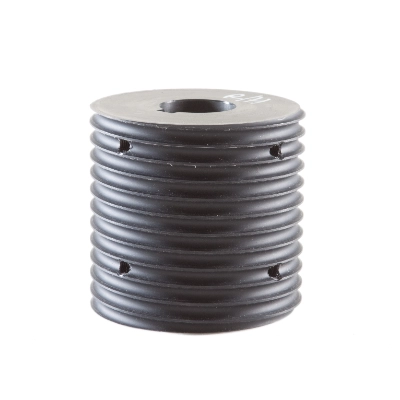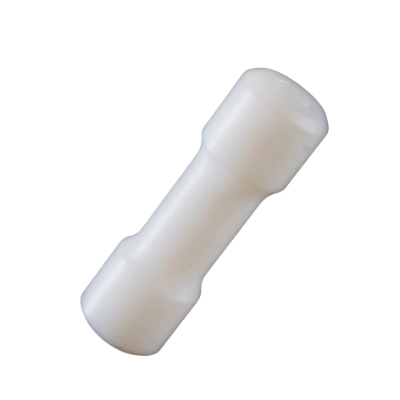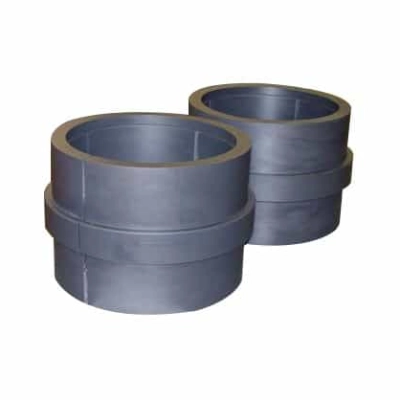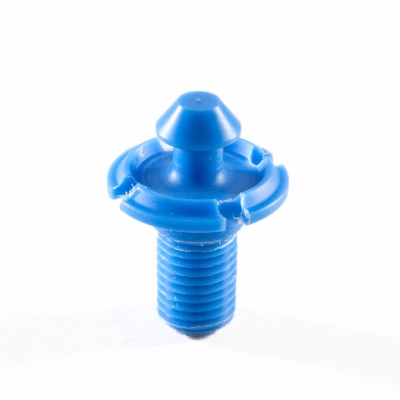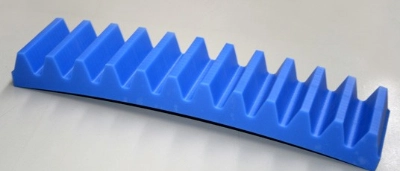
Nylon is one of the most widely used engineering plastics in the world. Its hard working components include gears, bearings, wheels, pulleys, wear pads,, and more. But to select the right grade, and avoid costly failures, you need to understand how nylon is produced, not just what it is.
How nylon is manufactured follows five key stages:
- Raw material extraction from petrochemicals
- Monomer production and purification
- Polymerisation (chain formation)
- Solidification and pelletising
- Forming into engineering products
Each step directly affects the final material’s strength, moisture behaviour, machinability, and performance in service.
This guide takes an engineering view of how nylon is formed, from raw monomers through to finished stock shapes like rods and sheets. We focus on industrial applications: how PA6 and PA66 are formed, how processing affects crystallinity and strength, and why that matters when your component is under load, heat, or constant motion.
Nylon Monomers and Raw Materials
To understand how nylon is formed, you need to start with its building blocks.
Every nylon component starts as a petrochemical. Crude oil is refined and chemically processed into the monomers that form nylon’s backbone.
For engineering applications, the two most important pathways are PA6 and PA66.
PA6 is built from a single monomer, caprolactam. This compound is derived from cyclohexane through a series of oxidation and rearrangement steps before being formed into a ring-shaped molecule. That ring structure is what allows PA6 to open up and link into long chains during polymerisation.
PA66, on the other hand, uses two monomers: hexamethylenediamine and adipic acid. These are produced through more complex petrochemical processes and must be combined in precise balance before polymerisation can begin.
At this stage, purity matters more than anything. Even small levels of contamination can carry through into the final material, showing up later as weak points, inconsistencies, or machining defects.
Polymerisation: How Nylon Chains Form
If you want to understand how nylon is formed, this is the point where it truly becomes a material.
As you recall, polymerisation is where small monomer molecules link together to form long, repeating chains.
For PA6, the process is known as ring-opening polymerisation. The caprolactam molecule opens under heat and pressure, then bonds with others to form continuous chains. The result is a material that is tough, slightly more flexible, and easier to process.
PA66 forms through a condensation reaction between hexamethylenediamine and adipic acid. As the chains grow, water is released and removed from the system. This process produces a more tightly packed, crystalline structure.
That structural difference matters. PA66’s higher crystallinity gives it greater stiffness and better performance at elevated temperatures. PA6, while slightly less rigid, offers improved impact resistance and more forgiving processing.
Here’s a comparison between PA6 and PA66 processing variables and their impact on performance.
| PA6 | PA66 |
|---|---|---|
Polymerisation Type | Ring-opening polymerisation (caprolactam) | Condensation polymerisation (HMDA + adipic acid) |
Reaction Temperature | ~240–260 °C | ~270–280 °C |
Reaction Time | Shorter (continuous process, faster cycle) | Longer (step-growth, staged reaction) |
Catalysts / Additives | Often minimal or acid catalysts to initiate ring opening | Typically no catalyst; relies on salt formation and heat |
By-products | None (no volatile by-product) | Water (must be removed during reaction) |
Chain-End Balance | Less controlled, more variable end groups | More controlled stoichiometry (balanced amine/acid ends) |
Resulting Structure | Lower crystallinity, more flexible chains | Higher crystallinity, tighter chain packing |
From Polymer to Pellets: Solidification and Chipping
Once polymerisation is complete, nylon exists as a hot, viscous melt. It’s not yet usable. It needs to be stabilised, shaped, and prepared for further processing.
The molten polymer is pushed through dies to form strands, which are then cooled in controlled conditions, either in a water bath or an air chill. This cooling stage controls how the internal crystalline structure forms. Cooling too quickly or unevenly can affect dimensional stability and long-term performance.
After cooling, the strands are cut into small, uniform 2–4mm pellets. These pellets are the standard form used in manufacturing. They flow easily, melt consistently, and allow for controlled processing in the next stage.
Then comes drying. This step has a direct impact on quality.
Nylon naturally absorbs moisture from the air. If that moisture isn’t removed, it turns to steam during processing, creating voids, surface defects, and weakened parts. For engineering applications, moisture must be reduced below 0.2% during the drying process to prevent these imperfections.
Forming Engineering Nylon: Extrusion, Casting, and Spinning
With dry pellets ready, nylon can now be formed into usable shapes. This is where the material becomes something engineers can actually work with.
Extrusion is the most common method. Pellets are melted and pushed through a die to create continuous shapes like rods, sheets, and tubes. These forms are then machined into finished components such as gears, bushings, and wear strips.
For oversized PA6 components, such as Ertalon 6PLA, casting is preferred. In this process, the monomer is polymerised in moulds and allowed to cool slowly. The result is a more uniform internal structure with lower stress, which is ideal for heavy-duty applications.
You’ll often hear about melt spinning in discussions of nylon production, but that’s largely relevant to textiles. In engineering, the focus stays on solid stock shapes.
Nylon Grades for Industrial Use
How nylon is formed directly affects how it behaves in service. A change in polymerisation method, cooling rate, or moisture content shows up in the quality of your component.
A more crystalline structure, like that found in non-filled PA66, delivers better heat resistance and stiffness. That makes it suitable for load-bearing parts and higher-temperature environments. Products include Ertalon 66SA.
PA66, filled with materials like Molybdenum Disulfide (MoS2) (Nylatron GS) or glass (Ertalon 66GF30), dramatically increases stiffness, dimensional stability, and wear resistance, making it ideal for high-load structural parts.
PA6, with its slightly more open structure, is a general-purpose grade nylon, and offers flexibility, better impact resistance and is often easier to machine. Products include Ertalon 6SA and Nylatron MC901.
Frequently Asked Questions
| What is Nylon produced from? | Nylon is produced from petrochemical raw materials that are chemically processed into monomers such as caprolactam or hexamethylenediamine and adipic acid. |
|---|---|
| Is Nylon easy to produce | Nylon production is a controlled chemical process. Achieving consistent engineering quality requires precise temperature control, purification, and moisture management. |
| Is Nylon human-made or natural? | Nylon is fully synthetic. It is a man-made polymer developed through chemical engineering. |
| What is Nylon most commonly used for? | In engineering, nylon is commonly used for gears, bearings, bushings, wear pads, and structural components. |
| What products are made of Nylon? | Nylon is used in industrial machinery components, automotive parts, conveyor systems, and electrical components. |
| How is Nylon useful in our daily lives? | Beyond engineering, nylon is used in everyday products, including clothing and household items (such as kitchen utensils and carpet), due to its strength, durability, and resistance to wear. |
| What is Nylon not good for? | Nylon can absorb moisture, which may affect dimensional stability. It may also require stabilisation for UV exposure. |
| How is Nylon formed? | Nylon is formed through polymerisation, where monomers react to create long-chain polymers that are then processed into pellets and shaped into engineering materials. |